History of Pillsbury United Communities & the Settlement House Movement
Introduction
Pillsbury United Communities traces its roots to Minneapolis’ Bethel Settlement, one of 400 settlement houses established between 1879 and 1910 across the nation to improve living conditions in city slums during the “Settlement House Movement.”
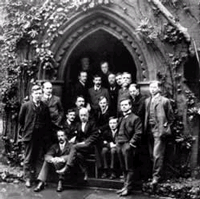
This movement, which began in 19th century England, produced many social policy initiatives and new ways of working to improve the conditions of the most excluded members of society. As a descendant of the Settlement House Movement, Pillsbury United Communities adheres to its founding principles – simple in concept, yet profound in impact: respect, reform, and reciprocity.
The Industrial Revolution & Toynbee Hall
The industrial revolution in 19th century England brought about significant improvements in technology, transportation, and communication; a massive population movement from rural to urban areas; and profound changes for workers. For the first time in history, city slums emerged. Families lived in horribly crowded, unsanitary housing. Healthcare was nonexistent; disease was rampant. There were few schools. Children were sent to work in factories. The draconian “Poor Laws” of England provided little relief. It was in this environment that Reverend Samuel and Henrietta Barnett planted the seeds of the Settlement House Movement.
In 1873, Reverend and Mrs. Barnett lived and worked at St. Jude’s Parish, described by the Reverend as “the worst parish in London.” For ten years, they worked tirelessly to improve the conditions in the impoverished community. Reverend Barnett became increasingly concerned with the causes of poverty around him. He believed they were largely moral, stemming from the division of classes rather than flaws intrinsic to poor people – a radical idea at the time, and one that would become the basis of the Settlement House Movement.
He and his wife took his ideas to Oxford, where he met Arnold Toynbee, an economic historian who shared many of his ideas about social conditions. In one of his last public addresses he said about the poor, “We – the middle classes I mean, not merely the very rich – we have neglected you; instead of justice we have offered you charity, and instead of sympathy we have offered you hard and unreal advice; but I think we are changing.”
Toynbee died in 1883, and as a memorial to him, Reverend Barnett advocated for the creation of a place in a poor area of London where university students might get to know workers and their problems through interaction and discussion. Here they could contribute to the betterment of the community by teaching, researching, performing public service, and learning about social reform. They could also provide a place – a physical space – where residents could meet, talk, plan, and learn. In 1884, Toynbee Hall was born, and it was there that the marriage of social justice and the practice of living among the poor, or “settling,” produced the beginning of what we now call The Settlement Way.
The student residents lived onsite in order to learn as much about the neighborhood as they could. They provided classes, social gatherings, summer camps, arts programs, clean-milk stations, baby clinics, nursery schools, and other innovative programs. They helped to organize their neighbors into community groups that could leverage more power than they could alone. The residents treated the neighborhood residents as equals. And they helped to promote the belief that social and economic conditions, rather than personal weakness, were the root causes of poverty.
The Settlement House Movement Spreads to the U.S.
The unique and pioneering ideas and values of Toynbee Hall spread quickly. During the next two decades, twenty-one settlement houses were established across Europe, and soon the movement made its way to the United States. By 1897 there were seventy-four settlements in the U.S., over 100 in 1900, and more than 400 by 1910. Most of these were in large cities such as New York, Boston and Chicago, but most smaller cities had at least one settlement. While most settlements had religious backing and were often founded by members of the clergy, they distinguished themselves from other charity organizations because they were secular. This allowed them to serve more people across ethnic and religious lines.
While the activities of each settlement house were different depending upon the needs of a particular neighborhood, they shared common goals and values. At the heart of the movement was a belief that healthier communities could be built, and that they could be built by first establishing healthy relationships with its members. They were not simply dispensing charity – rather than asking residents, “What can we do for you?” they instead asked, “What can we do together?” It was an optimistic, friendly, personal and hopeful movement in comparison to the “charity visitor” who rarely took the time to get to know or understand the poor.
Jane Addams was one of the most influential leaders of the American settlement movement. After visiting Toynbee Hall, she returned to her home in Chicago and opened Hull House in 1889. She moved into a run-down mansion in a very poor neighborhood and spent weeks scrubbing and preparing it for residents. Babies, dying by the hundreds because of ignorance and malnutrition, were her first concern. She and the other residents invited mothers into Hull House to bathe their children, and went into the surrounding tenements to help make safe places for kids to sleep. Addams pointed out to a wealthy landowner in the neighborhood that he owned several “filthy firetraps, owned by prostitutes.” She recommended that he tear them down and donate the land to her. He did, and in 1892 Addams opened the first free public playground in Chicago.
In addition to addressing concerns in the neighborhood, Addams went a step further and demanded factory safety laws, sanitation legislation, educational reform, and the prohibition of child labor. She, like many other settlement leaders across the United States, was pioneering a course that social workers would follow for the next century.
Minneapolis Settlements
At the same time that Addams was establishing Hull House, the Settlement House Movement started in Minneapolis. In late 19th century Minneapolis, conditions in the city were similar to those in other large cities like Chicago and New York. New immigrants and factory workers were living in crowded slums, poor sanitation caused illnesses and even death, and there was increasing disparity between the rich and the poor. Prostitution, gambling, alcoholism and crime filled the neighborhoods.
In 1879, Plymouth Congregational Church started the Plymouth Mission in an effort to address these concerns. Katherine Plant took over the mission in 1897 and reorganized it to become Bethel Settlement. Bethel offered a free kindergarten, industrial training, and sewing classes. A day nursery allowed mothers to go to work. The settlement grew, and by the turn of the century they needed more space.
In 1905, John and Charles Pillsbury, brothers who were greatly benefiting from the success of their flour mills, gave $40,000 towards the construction of a new facility. The building, located near the intersection of what is now Cedar and Riverside Avenues, was completed in 1906, and named Pillsbury House in honor of their parents. It then added a health clinic, a women’s employment office, home economics and arts classes, and boys’ and girls’ clubs. In 1920, Pillsbury House purchased land in Waconia, Minnesota, and established Camp Manakiki, a place where children and their mothers could go to escape the city and enjoy the country.
Across town, another settlement house was growing quickly. Established in 1897, Unity House differed from many other settlements in that it was founded by social entrepreneurs rather than religious groups or individuals. Their first annual report read that as a social settlement, they had “no creed but the golden rule and work for man.” They served nearly 95,000 people each year by the 1920s, offering many of the same kinds of programs offered at Pillsbury House.
For many people, the settlement house provided the first safe, clean and inviting place they had ever been. It allowed many mothers to go to work for the first time. And countless children made friends, found mentors and learned skills that they would carry with them for the rest of their lives.
Settlement House Movement in the 20th Century
By the 1920s, settlement houses across the country began to change. Social work was becoming more professionalized, more concerned with addressing individual psychiatric issues than systemic, societal problems. Due to financial problems, many settlement houses became increasingly dependent on the United Fund and Community Chests. Prior to this time, most settlements were funded entirely by individual donations and churches, and the residents themselves often paid room and board. It was no longer viable by the 1930s to support full-time residents and round-the-clock services. Many settlements began calling themselves neighborhood or community centers at this time.
Still, settlement houses remained true to their heritage, they changed as the neighborhoods around them changed; they were a flexible yet consistent presence in Minneapolis’ poorest neighborhoods. The programs they offered were a means to building relationships with people and in turn building healthier communities. In 1936, Mary Kingsbury Simkhovitch, from Greenwich House in New York, wrote the following:
Knowledge of the neighborhood, its physical structure, social groupings and authoritative leaders is superficial unless it is based on knowledge of the personal life of individuals, together with an understanding of their home life, their work life, and their community interests.
In the century since the founding of the Settlement House Movement, settlement work has become extremely diverse, and perhaps the only consistent theme among the nation’s settlements today is their flexibility and sensitivity to the needs of the neighborhood. The impact of the Settlement House Movement is widespread. Today, it is estimated that there are more than 900 settlement houses in the United States, and thousands more in over thirty countries throughout the world. You may know them as “community or neighborhood centers,” but they are all descendants of a movement begun over 100 years ago, a movement that is even more relevant in today’s context.
“Programs and methods have changed in response to war, depression, prosperity, and racial crisis, and though settlement efforts have shifted along a spectrum from service to reform, settlement house and neighborhood work continues to emphasize sharing and brotherhood. The nation of the agrarian dream had been irretrievably lost in the industrial revolution, but through patient work with fellow citizens a second nation might be created and neighborliness restored.” Andrea Hinding, “Neighborhood and Nation: Settlement Houses in America,” 1975
Evolution of Pillsbury United Communities
Pillsbury United Communities is the result of many mergers during the past century. These mergers often occurred to streamline services, to increase capabilities, to save money, or to ensure a continued presence in the areas of greatest need.
The original Pillsbury House building was torn down in the 1960s and rebuilt in South Minneapolis at 35th and Chicago. Waite House, located in the Phillips neighborhood, is the result of multiple mergers prior to 1958, and was named after Edward F. Waite, a well-respected juvenile court judge. Unity House and Wells Memorial merged with Northside Settlement Services in 1967, and Pillsbury House merged with and Waite House to become Pillsbury-Waite Neighborhood Services. In 1984, north and south Minneapolis were linked through the merger of Northside Settlement Services and Pillsbury United Neighborhood Services to form what is now Pillsbury United Communities.
Pillsbury United Communities is currently the largest settlement house-based organization in the state, and one of the largest in the country, with seventeen locations throughout the city. Every year, nearly 35,000 people walk through our doors.
Although we are a large organization, we continue to be small where it counts. At the core of the settlement philosophy is a belief that personal relationships with our neighbors are essential to making a difference in people’s lives and in vitalizing healthier communities.
Who We Are Today
Pillsbury United Communities is an organization that honors its past. Settlement House values and ideals are a crucial part of our mission to create choice, change and connection both in our neighborhoods and in the lives of individuals. When we examine our history in this community, it is striking how similar the needs of the people we encounter today are to those we served 100 years ago. And it goes without saying that the need for a healthy community and a good neighbor will always exist.
Yet we are constantly looking toward the future, and in the tradition of the Settlement House Movement, seek to be more agile and flexible, and able to change with the neighborhoods we care so much about. We understand the importance of bedrock services like after-school programs for kids, childcare, and food shelves. But we also know that vital communities require a wider array of efforts, and so we deliver employment training for single dads; supportive housing for homeless families; domestic abuse advocacy for African women; translation services for Hmong people needing health care; tax assistance for the elderly and low-income residents, theatre classes for troubled teens; family advocacy for at-risk youth, and many, many other programs. We open our doors to our neighbors and celebrate with them; we host birthday parties, barbecues, block parties, recognition dinners, holiday celebrations and political forums. At the heart of all of these activities are the personal connections we make with our neighbors, and the connections they make with each other. We are constantly evolving, yet we remain rooted in tradition of the Settlement House Way.
Where We Are Headed
During the past few years, we have spent significant time examining key trends in our neighborhoods and in society in general. We have spoken with staff, participants, government officials, neighborhood leaders, church groups, corporate leaders, and peer agencies about where they think agencies such as ours ought to be headed.
In these frequent and lengthy discussions, we learned that economic, social, racial divisions continue to be critical issues in our city. The movement of political power from urban areas to the suburbs has left many city residents feeling abandoned. There is a sense that the poor are responsible for their own fate – Minnesota’s long tradition as a progressive state feels threatened. People in the core city are feeling increasingly isolated.
In this time of growing need, there also seems to be a general dissatisfaction with the large organizations that are supposed to exist to address these needs – including government, schools, medicine, and social services. Instead of working together, these organizations are fragmented and uncoordinated. Funding preferences toward smaller and more entrepreneurial organizations means that creating these partnerships and alliances is ever more difficult.
In a recent article in the Minneapolis Star Tribune, Jim Boyd wrote:
A movement is afoot to undo most of the reforms that sprang from the settlement house movement. Its proponents don’t seek to tweak the social-welfare system or curb its excesses. They seek to obliterate it . . . to return us to the individualism of the frontier days and the robber-baron era, when the poor and the newly arrived were looked down upon and when where was a quite small middle class.
How are organizations like Pillsbury United Communities to survive and thrive in this environment, and more importantly, how are the people who live in our communities to survive and thrive? While we don’t claim to have all of the answers, we are working on a number of strategies that we think will begin to address these concerns.
Our goal is to vitalize healthy communities by creating, innovating & collaborating with diverse individuals and groups; providing open, attractive, welcoming & safe spaces for people to participate, connect, and organize; and bridging the gaps between those who are affected by decisions and those who make them.
At Pillsbury United Communities, we are taking an approach that is very challenging yet critical: that is, we are trying to be big and small at the same time. “Big” when it comes to community impact and organizational efficiency, but “small” when it comes to relationships and people. We get to know our neighbors – at the heart of all of these activities are the personal connections we make with them, and the connections they make with each other.
As we look toward our future as an organization, we find that the basic tenets of the settlement way are still central to our mission:
- We will continue to show dignity and respect toward our neighbors by developing top-rate facilities, programs, services and staff.
- We will promote social reform and democracy by providing training, mentorship and resources to our neighbors, which will to help them take initiative on their own behalf and become engaged owners of their communities
- We will vitalize healthy communities by creating, innovating & collaborating with diverse individuals and groups, bringing people from diverse backgrounds together to share their talents and create an environment of reciprocity and solidarity.
The Settlement Way is alive and well, and continues to create healthier communities throughout the world. And at Pillsbury United Communities, we will continue to honor the three “Rs” – respect, reform and reciprocity – to create choice, change, and connection in people’s lives: one person at a time.

